Mr Ahmadinejad said he would try to make his blog entries shorterIranian President Mahmoud Ahmadinejad has joined a burgeoning international community - by starting his own weblog.
The launch of www.ahmadinejad.ir was reported on state TV, which urged users to send in messages to the president.
Mr Ahmadinejad's first posting, entitled autobiography, tells of his childhood, Iran's Islamic revolution, and the country's war with Iraq. The blog includes a poll asking if users think the US and Israel are trying to trigger a new world war.
There is a postform for users to send in questions for the president, and a picture gallery containing a series of images of the blogger himself.
Mr Ahmadinejad said he would try to make his blog entries shorterIranian President Mahmoud Ahmadinejad has joined a burgeoning international community - by starting his own weblog.
The launch of www.ahmadinejad.ir was reported on state TV, which urged users to send in messages to the president.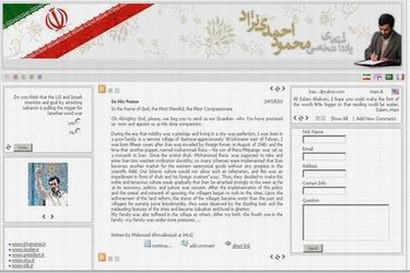 Mr Ahmadinejad's first posting, entitled autobiography, tells of his childhood, Iran's Islamic revolution, and the country's war with Iraq. The blog includes a poll asking if users think the US and Israel are trying to trigger a new world war.
There is a postform for users to send in questions for the president, and a picture gallery containing a series of images of the blogger himself.
The move by Mr Ahmadinejad comes amid continuing internet censorship by the Iranian government. In a country where the media is strictly controlled, the internet has become the main forum for dissident voices. But in its bid to crack down on anti-government bloggers, the government uses one of the most sophisticated internet censorship systems in the world.
Such restrictions will not pose a problem for the president. However, at the end of his first posting - which runs to more than 2,000 words in English - he promises to try to keep things "shorter and simpler" in future."With hope in God, I intend to wholeheartedly complete my talk in future with allotted 15 minutes," he writes.
Nose bleed
Mr Ahmadinejad's first entry on his blog, which is available in Persian, Arabic, English and French and includes an RSS feed to get future new entries to readers, is dated Friday.
He begins by telling users of his humble origins. "During the era that nobility was a prestige and living in a city was perfection, I was born in a poor family in a remote village of Garmsar - approximately 90 kilometres west of Tehran," he writes.
The internet is extremely popular in Iran, but bloggers face strict censorship
His father was a "hard-bitten toiler blacksmith" and a "pious man", who had decided to move the family to Tehran when Mr Ahmadinejad was just a year old.
Describing himself as a "distinguished student", the president tells how he excelled at school, coming 132nd out of more than 400,000 students to take a university entrance test - despite suffering from a nose bleed at the time.
He talks about his admiration and affection for the leader of the Islamic revolution Ayatollah Ruhollah Khomeini, and discusses Iran's war with Iraq, calling former Iraqi leader Saddam Hussein an "aggressor" who was "intoxicated with power".
The US is also heavily criticised by the president. At one point he describes it as "Great Satan USA" for what he says was its support for the "terrorist groups" which had tried to collapse Iran's Islamic government.
And the blog's current poll asks the question: "Do you think that the US and Israeli intention and goal by attacking Lebanon is pulling the trigger for another world war?"
'Publicity stunt'
It is not yet clear how well Mr Ahmadinejad's blog will be received. User figures already appear high - by 1100 BST on Monday, nearly 12,000 people had taken part in the online vote.
But Keivan Mehrgan, a Tehran-based blogger, told the Associated Press news agency he thought the president's efforts were merely a publicity stunt.
"Ahmadinejad used to have nothing to do with the internet and even talked against journalists and bloggers before he became president," he was quoted as saying.
Meanwhile, in a move some suggest is part of the same search for a wider international audience, President Ahmadninejad also gave a rare interview to American television.
In extracts broadcast by the BBC on Monday, Mr Ahmadinejad condemned President Bush for wanting to solve the world's problems by force, and for "blindly supporting" Israel in its conflict with Hezbollah.
He also flatly denied Iran was seeking nuclear weapons. "We want to have access to nuclear technology. We want to produce fuel," he said.
"Do you not think that the most important issue of the world of tomorrow will be energy? We think that Mr Bush's team and the parties that support him want to monopolise energy resources in the world."
The BBC's Bridget Kendall, at the United Nations, says Mr Ahmadinejad's decision to reach out to speak America at this moment - in the wake of the Lebanon conflict - was no accident.
President Ahmadinejad wanted to play on all the doubts about American foreign policy, and counter the notion that Iran is run by mad mullahs trying to get nuclear weapons, our correspondent says.
Source: BBC,
Indonesian Version, click here
Aug 21, 2006
Iran's president launches weblog
In Search of America
Why America becomes a superpower country? It can set out the image and view the world about it. All people in the world exactly know America. They have seen, heard, and read about United States for most of their lives.
“This land is your land” is hegemony of America. Our mind are influenced that all things that related with America need to know. All the images and views of America are heard, seen, read, or observe outside the United States. America seems to be everywhere but everywhere is not America. Nevertheless, American images and products are not always welcome. In both, East and West has tried to discourage or has simply forbidden the inflow of unwanted Americana.
It is very difficult for a foreigner to grasp the size of the U.S. and the great variety of life. Most Americans take the size and variety of their country for granted. For a long period of time it has been popular to describe the typical American character or even “the American way of life,” as if there were only one. To attempt this with the more homogeneous people and nations of America, the results have often been disastrous, if not just comical.
American society is the most open and, at the same time, most intensely and continually self-critical in the world. Any country that was founded on ideals, as the United States was, and that declares them openly and defines itself through them, will constantly have to measure the distance between where it is and where it should be. The distance between the reality of life and the hope for a better one is also the basis of the American Dream. It is has been hotly argued not only by Americans, but by the rest of the world as well. This debate about America is at the center of what it means to be an American and the strength of the argument reflect the view that America is different or should be. The literature of America has also demonstrated this tradition of self-criticism.
Many Americans feel that such continuing self-tradition, the terrible attention by the media, the publishing of the things best keep secret, the hunts for scandals, has gone too far. They point out that in few other western societies can political cartoonists so openly ridicule their leader.
America could be described as the polluted land, the despoiler of a great wilderness, the inventor of the throw-away culture. Or it could be described as the first country to set aside national parks, among the first to ban DDT, the culture that created the world “ recycling,” a nation where women would be jeered if they wore furs of a cheetah or leopard. America could be portrayed as a nation of intolerance and hate, or the last refuge for millions, where all religions under the sun are found.
America is neither a land where gold is found on the streets nor the land where all streets are filled with soup-lines and drunks, should go without saying. If someone today come to America already knowing what they will find, then they will find it, be it riches or grim poverty. Yet, if one is willing to give those first Americans a chance to introduce themselves, then we stand a better chance of discovering where America is, and who Americans are.
Jul 15, 2006
Right Islam vs. Wrong Islam
By Abdurrahman Wahid*

Imagine the impact of a single nuclear bomb detonated in New York, London, Paris, Sydney or L.A.! What about two or three? The entire edifice of modern civilization is built on economic and technological foundations that terrorists hope to collapse with nuclear attacks like so many fishing huts in the wake of a tsunami.
Just two small, well-placed bombs devastated Bali's tourist economy in 2002 and sent much of its population back to the rice fields and out to sea, to fill their empty bellies. What would be the effect of a global economic crisis in the wake of attacks far more devastating than those of Bali or 9/11?
It is time for people of good will from every faith and nation to recognize that a terrible danger threatens humanity. We cannot afford to continue "business as usual" in the face of this existential threat. Rather, we must set aside our international and partisan bickering, and join to confront the danger that lies before us.
****
An extreme and perverse ideology in the minds of fanatics is what directly threatens us (specifically, Wahhabi/Salafi ideology--a minority fundamentalist religious cult fueled by petrodollars). Yet underlying, enabling and exacerbating this threat of religious extremism is a global crisis of misunderstanding.
All too many Muslims fail to grasp Islam, which teaches one to be lenient towards others and to understand their value systems, knowing that these are tolerated by Islam as a religion. The essence of Islam is encapsulated in the words of the Quran, "For you, your religion; for me, my religion." That is the essence of tolerance. Religious fanatics--either purposely or out of ignorance--pervert Islam into a dogma of intolerance, hatred and bloodshed. They justify their brutality with slogans such as "Islam is above everything else." They seek to intimidate and subdue anyone who does not share their extremist views, regardless of nationality or religion. While a few are quick to shed blood themselves, countless millions of others sympathize with their violent actions, or join in the complicity of silence.
This crisis of misunderstanding--of Islam by Muslims themselves--is compounded by the failure of governments, people of other faiths, and the majority of well-intentioned Muslims to resist, isolate and discredit this dangerous ideology. The crisis thus afflicts Muslims and non-Muslims alike, with tragic consequences. Failure to understand the true nature of Islam permits the continued radicalization of Muslims world-wide, while blinding the rest of humanity to a solution which hides in plain sight.
The most effective way to overcome Islamist extremism is to explain what Islam truly is to Muslims and non-Muslims alike. Without that explanation, people will tend to accept the unrefuted extremist view--further radicalizing Muslims, and turning the rest of the world against Islam itself.
Accomplishing this task will be neither quick nor easy. In recent decades, Wahhabi/Salafi ideology has made substantial inroads throughout the Muslim world. Islamic fundamentalism has become a well-financed, multifaceted global movement that operates like a juggernaut in much of the developing world, and even among immigrant Muslim communities in the West. To neutralize the virulent ideology that underlies fundamentalist terrorism and threatens the very foundations of modern civilization, we must identify its advocates, understand their goals and strategies, evaluate their strengths and weaknesses, and effectively counter their every move. What we are talking about is nothing less than a global struggle for the soul of Islam.
****
The Sunni (as opposed to Shiite) fundamentalists' goals generally include: claiming to restore the perfection of the early Islam practiced by Muhammad and his companions, who are known in Arabic as al-Salaf al-Salih, "the Righteous Ancestors"; establishing a utopian society based on these Salafi principles, by imposing their interpretation of Islamic law on all members of society; annihilating local variants of Islam in the name of authenticity and purity; transforming Islam from a personal faith into an authoritarian political system; establishing a pan-Islamic caliphate governed according to the strict tenets of Salafi Islam, and often conceived as stretching from Morocco to Indonesia and the Philippines; and, ultimately, bringing the entire world under the sway of their extremist ideology.
Fundamentalist strategy is often simple as well as brilliant. Extremists are quick to drape themselves in the mantle of Islam and declare their opponents kafir, or infidels, and thus smooth the way for slaughtering nonfundamentalist Muslims. Their theology rests upon a simplistic, literal and highly selective reading of the Quran and Sunnah (prophetic traditions), through which they seek to entrap the world-wide Muslim community in the confines of their narrow ideological grasp. Expansionist by nature, most fundamentalist groups constantly probe for weakness and an opportunity to strike, at any time or place, to further their authoritarian goals.
The armed ghazis (Islamic warriors) raiding from New York to Jakarta, Istanbul, Baghdad, London and Madrid are only the tip of the iceberg, forerunners of a vast and growing population that shares their radical views and ultimate objectives. The formidable strengths of this worldwide fundamentalist movement include:
1) An aggressive program with clear ideological and political goals; 2) immense funding from oil-rich Wahhabi sponsors; 3) the ability to distribute funds in impoverished areas to buy loyalty and power; 4) a claim to and aura of religious authenticity and Arab prestige; 5) an appeal to Islamic identity, pride and history; 6) an ability to blend into the much larger traditionalist masses and blur the distinction between moderate Islam and their brand of religious extremism; 7) full-time commitment by its agents/leadership; 8) networks of Islamic schools that propagate extremism; 9) the absence of organized opposition in the Islamic world; 10) a global network of fundamentalist imams who guide their flocks to extremism; 11) a well-oiled "machine" established to translate, publish and distribute Wahhabi/Salafi propaganda and disseminate its ideology throughout the world; 12) scholarships for locals to study in Saudi Arabia and return with degrees and indoctrination, to serve as future leaders; 13) the ability to cross national and cultural borders in the name of religion; 14) Internet communication; and 15) the reluctance of many national governments to supervise or control this entire process.
We must employ effective strategies to counter each of these fundamentalist strengths. This can be accomplished only by bringing the combined weight of the vast majority of peace-loving Muslims, and the non-Muslim world, to bear in a coordinated global campaign whose goal is to resolve the crisis of misunderstanding that threatens to engulf our entire world.
****
An effective counterstrategy must be based upon a realistic assessment of our own strengths and weaknesses in the face of religious extremism and terror. Disunity, of course, has proved fatal to countless human societies faced with a similar existential threat. A lack of seriousness in confronting the imminent danger is likewise often fatal. Those who seek to promote a peaceful and tolerant understanding of Islam must overcome the paralyzing effects of inertia, and harness a number of actual or potential strengths, which can play a key role in neutralizing fundamentalist ideology. These strengths not only are assets in the struggle with religious extremism, but in their mirror form they point to the weakness at the heart of fundamentalist ideology. They are:
1) Human dignity, which demands freedom of conscience and rejects the forced imposition of religious views; 2) the ability to mobilize immense resources to bring to bear on this problem, once it is identified and a global commitment is made to solve it; 3) the ability to leverage resources by supporting individuals and organizations that truly embrace a peaceful and tolerant Islam; 4) nearly 1,400 years of Islamic traditions and spirituality, which are inimical to fundamentalist ideology; 5) appeals to local and national--as well as Islamic--culture/traditions/pride; 6) the power of the feminine spirit, and the fact that half of humanity consists of women, who have an inherent stake in the outcome of this struggle; 7) traditional and Sufi leadership and masses, who are not yet radicalized (strong numeric advantage: 85% to 90% of the world's 1.3 billion Muslims); 8) the ability to harness networks of Islamic schools to propagate a peaceful and tolerant Islam; 9) the natural tendency of like-minded people to work together when alerted to a common danger; 10) the ability to form a global network of like-minded individuals, organizations and opinion leaders to promote moderate and progressive ideas throughout the Muslim world; 11) the existence of a counterideology, in the form of traditional, Sufi and modern Islamic teachings, and the ability to translate such works into key languages; 12) the benefits of modernity, for all its flaws, and the widespread appeal of popular culture; 13) the ability to cross national and cultural borders in the name of religion; 14) Internet communications, to disseminate progressive views--linking and inspiring like-minded individuals and organizations throughout the world; 15) the nation-state; and 16) the universal human desire for freedom, justice and a better life for oneself and loved ones.
Though potentially decisive, most of these advantages remain latent or diffuse, and require mobilization to be effective in confronting fundamentalist ideology. In addition, no effort to defeat religious extremism can succeed without ultimately cutting off the flow of petrodollars used to finance that extremism, from Leeds to Jakarta.
****
Only by recognizing the problem, putting an end to the bickering within and between nation-states, and adopting a coherent long-term plan (executed with international leadership and commitment) can we begin to apply the brakes to the rampant spread of extremist ideas and hope to resolve the world's crisis of misunderstanding before the global economy and modern civilization itself begin to crumble in the face of truly devastating attacks.
Muslims themselves can and must propagate an understanding of the "right" Islam, and thereby discredit extremist ideology. Yet to accomplish this task requires the understanding and support of like-minded individuals, organizations and governments throughout the world. Our goal must be to illuminate the hearts and minds of humanity, and offer a compelling alternate vision of Islam, one that banishes the fanatical ideology of hatred to the darkness from which it emerged.
The writer is former president of Indonesia, founder the Wahid Institute, Jakarta.
Source: The Wall Street Journal, 30/12/2005, GusDur.net
Mar 3, 2006
New Curriculum Plots Students to Meet Work Field
Starting from 2002, Faculty of Letters of Diponegoro University has put a new curriculum. This curriculum is published based on the decree of National Education Minister No. 232/U/2000. Although the decree was published in 2000, the implementation comes to be effective in 2002, which means, to be officially applied for students of 2002.
The new curriculum, known as curriculum of 2000, reveals many changes. Among the changes are the replacement of KKN with an apprenticeship program and the offering of a non-thesis line. KKN, which previously provided students with a chance to deliver their public service, is now irrelevant. As Prihatmi, the dean of faculty of Letters, remarked, so far KKN has made few benefits since students could not really implement what they have got in the university for people. It is therefore useless. Often, what occurs in the field is not what the purpose has designed to be, “say, it is just clumsy that students of faculty of Letters be ordered to build a bridge,†said she disappointedly.
Agus Subiyanto, the new head of English Department, analyses that society has a different condition today. In the past, people warmly welcomed the visit of students who carried out KKN. But at present, people do not really need students’ help. It is sadden to say that students’ visit may just bring a bother for the local people and the area as well.
Next is the offering of a non-thesis line. The line is an option for the students other than the thesis-line. It is also a requirement to get S1 degree. By this policy, students are given an academic freedom to decide which line they prefer to complete in their study. At the beginning, this policy was implemented on the purpose to prepare students for work field, and also to help students who find difficulties in arranging a thesis. “In the work field, we are to be practical; the experience of research is less needed. Besides, we are also required to pursue other skills, which support the field we are majoring," said Drs. Muallimin, M.A., the secretary of English Department.
In agreement to Mualimin, Agus Subiyanto added that this decision has been prudently discussed in the meeting. “And we have also got suggestion from the alumni who are now working. So we did not decide it single-handedly,†he explained.
Not all departments in the Faculty of Letters agree with this policy. The only department which is still arguing the non-thesis line is the Department of History, whereas two other departments agree with the policy. Prihatmi, the first person in the faculty of Letters, notes that the Department of History students are suggested to take a thesis. As for other departments, it will be no problem, because the Department of History is closely related to conduct a research.
Our faculty is in fact not the pioneer of implementing a non-thesis line; University of Indonesia (UI) has pioneered this idea and has started it a couple of years ago. Other state universities (PTN) now start following this idea. UNDIP is one of them, which will implement this policy for the Department of Indonesia students and English Department in the academic year of 2002.
In addition to the change of KKN and the non-thesis line offer, there are still many changes in this new curriculum. Several subjects that are considered irrelevant will be deleted. New subjects then appear to replace them. The SKS of lectures such as Man and Culture of Indonesia (MKI) and Indonesian Language in the English Department is simplified into 2 SKS, which previously were 4 SKS.
Some subjects that are considered still confusing have also been corrected. For example: speaking, grammar, listening, writing, and translation. Formerly, the name of these subjects used sequential number, but they are now changed to be in level; namely basic, intermediate, upper-intermediate, and advance, despite the material are basically same.
So far, curriculum of 2000 is the latest curriculum which is implemented in the Faculty of Letters. The lecturing material is based on the former curriculum textbook that was released in 2002. For a temporal time, the textbook of curriculum 2000 is no longer published. “In this year, 2003, the textbook guidance is not published anymore, because it will be revised. Consequently, the students of 2003, especially the English Department students and other departments have not got the manual book yet. For the English Department, it has been planned to publish the revision of the 2000 curriculum as soon as everything is done. We plan to socialize this revision to the students of 2000 and 2003,†said Agus Subiyantoâ€.
There are three subjects that are optionally offered in the Non Thesis line. They are Journalism, Applied Linguistics and ……….. Apart from revising the curriculum of 2000, the department also offers new subjects, such as Seminar on Grammar, Entrepreneurship, and TOEFL/IELT Preparation. Previously, such subjects were not presented. TOEFL/IELT Preparation is offered in the fifth semester. In this case, the department will cooperate with the Public Service Institution (LPM). Meanwhile, to hold a TOEFL test, SEU/MLC (Multi Language Center) will manage. The department also planned that the students will get a certificate.
What Do They Say about the New Curriculum?
Curriculums of 2000, which will soon be revised, are supposed to bring effect to the Faculty of Letters students. This effect can be positive or negative. Non-thesis line a breakthrough program published out by the Department of English and the Department of Indonesia. It surely has effect on the students themselves.
Toni, a student of English Department 2000 said that by the implementation of non-thesis line there would be a very small percentage of students who take the thesis line. It is because the non-thesis line is easier. Meanwhile, Ade, a student of English Department 2002 gets worried to take the non-thesis line. She is afraid that later she will have difficulties to continue her study.
It is Puji, a student of English Department 2002, different from Toni and Ade, who sees no problem with non-thesis line. Besides, it will be helpful for students who are completing thesis. He argues that the subjects offered in non-thesis line are good.
About the abolition of KKN, most of students stated that they do agree. Toni declared that he really supported this policy. He said that by an apprenticeship, students could largely apply their knowledge they have got from university. It is different from KKN of which the application is unclear.
Nevertheless, there are some students who disagree with the abolition of KKN. Dipta, a student of 2002, said that the knowledge that students got in campus is not to be business-oriented only, but also to be delivered for society. He emphasized the importance of KKN considering that the students will later on enter the society after they finish their study.
When Rahayu Prihatmi was confirmed about which is better, thesis or non-thesis, the dean of Faculty of Letters said that both of them are good. It is just what the students want to choose. They know their own capabilities; if they are able to write a thesis and have desire to do some research, it will be no problem.
Agus Subiyanto, the head of English Department, proposes the same opinion with Sri Rahayu. He added that for non-thesis line, the offered subjects are not inferior to the thesis line. Responding the worry of a few of the students who will take thesis line, he considered that there must certainly be one or more students who have strong desire to do a research. In his opinion, so to say, there would be students who undertake thesis line.*
Feb 10, 2006
Special Interview About New Curriculum
"It is an option, you can choose which one is best for you..."
In this issue, Miracle presents the figure of the new head of English Department, Faculty of Letters, Diponegoro University. Having been the chief of English Department since February 2004, Mr. Agus Subiyanto proposes several programs to develop this department. More information on his figure is reported by Miracle Crew, Mh. Sulhanudin as follows:
We wonder if you would like to tell our readers about yourself.
Well, I was born in Pati on August 14th 1964. Today, I live in Jl. Tlogo Berlian No. 3 Semarang. I took my SI degree in Linguistics in Faculty of Letters of Diponegoro University and graduated in 1989. One year later, I started giving a lecture in this faculty. Then, I enrolled my study at The Australian National University and graduated in 1999. I was assigned to be a secretary of English Department for four years, in the period of 2000-2004. And now this year, I am again given a mandate to manage this department.
As the head of this department, could you please tell us your plans?
First of all, I intend to develop this department because it is widely known that the department has got accreditation for its academic achievement. We are therefore obliged to maintain our achievement.
We (he and his colleagues,red) have discussed about the revision of the curriculum of 2000. In the curriculum, there are five replacement subjects of Non Thesis line. We have agreed to simplify into three subjects, which each of them is offered in 2 SKS (Satuan Kredit Semester). We also add some new subjects. They are Seminar on Grammar, Entrepreneurship, Apprenticeship, and TOEFL/IELT preparation.
Is there any other plans?
Well, in order to develop this department, we have made a solid team to complete the proposal of competence. Last year we submitted a proposal of competence to the Directorate of High Education or DIKTI (Direktorat Pendidikan Tinggi), but unluckily we failed. By preparing a solid team, I truly expect our proposal will be approved.
Then, is there any relation of submitting the proposal to DIKTI with your plan to develop this department?
Certainly yes. If our proposal is approved, DIKTI will fund our research. And we will allocate a part of the fund to upgrade the facilities, such as improving our language laboratory and many others.
Back to the revision of curriculum, a few days ago, Miracle conducted a poll about the curriculum of 2000 and its change. Many students are afraid that they will have difficulties to continue their study, what's your oppinion?
Actually, this model has been applied in University of Indonesia (UI) a couple of years ago. We will apply it starting from student of 2002. UI does not call for undergraduate students to take a thesis as the requirement of their graduation. Other universities, however, may oblige their students to take a thesis. It depends on the policy each university applies. So, you don't need to be afraid that you will not be able to continue your study.
On the other hand, many students prefer taking the non thesis line to taking the thesis line. Is it because that the non thesis line is simpler? Are you not afraid that there will only be a few students who take the thesis line?
Actually, the main purpose of the curriculum is to help students who want to get a job. In the work field, if you apply for a post in a company, you will not be asked about your thesis. Therefore, they do not need take a thesis or conduct a research. But thesis is important for the students who strongly intend to conduct a research. It is an option though, and I think you can estimate which is best for you.
*Published in Miracle June-July 2004
Profile of Mr Bill Oberlin
"...I enjoy learning Indonesian language and Cultures"
Bill Oberlin, a guest lecturer from USA, has been teaching in English Department of Faculty of Letters, Diponegoro University since 2001. He thinks that people here are friendly. The students here are respectful, they respect the others. Such condition have made him enjoy teaching in this department.
After teaching for more than a year, he found some students having problems in learning English because of its difficulties in term of pronunciation and its different verb form. In his observation, so far, some students are reluctant and hesitant to use English in their daily communication since they feel uncomfortable to speak English.
In order to encourage the students to use English outside the class “Speaking Class, red--, he always emphasizes on the importance of practicing English to the students. He asks the students to practice it everywhere. He takes himself as a sample. He tries to practice his language of Indonesian frequently. For instance, he used to practice it when he comes home from his work, or when he is somewhere with his children.
He admits that besides learning Indonesian language, lately, he is also enjoying learning Indonesian culture as well as Javanese culture. In his vacant time of teaching activity, he makes his time for learning Javanese language with his neighbors since the people in Salatiga, a town where he lives, mostly speak in Javanese language.
Hearing on his statement above, crews of Miracle who are interviewing Mr. Bill, his nickname- became sour. That day, the small cafe where we had the interview was very noisy. Yet, his smile appearing from his friendly face made the situation more intimate and chummy. We continue enjoying our meals then continuing our dialogue
Then he told us more about his first experience of visiting Indonesia. The first time coming to Indonesia, he purposed to conduct a construction project in Kalimantan.. At that time, he had never been in Indonesia before.
Because of his first visit in 1998, he really enjoyed his time in Indonesia and studied more about the culture and the people. Then in 2001, he decided to move to Bandung with his family. He and his wife began to study Bahasa Indonesia while spending their time to teach English in a Private English Office in Bandung.
Later on, they decided to move to Central Java as his office wanted to open a new office in Salatiga. To know more about Salatiga, he started to try to speak with other teachers, others private English schools and some universities, including Faculty of Letters, Diponegoro University. Finally, he was offered to teach English in English Department.
He remembered his teaching for the first time, a long with the attack of America on Irak, and he is the only American people in this Faculty. Fortunately, the students were so kind and he talked about the issue with the students.
When asked about the condition of English Department in this faculty, he admitted that it is very good. We had worked together in curriculum planning and the teachers whom I work with have a lot of respect for their skill and dedication. He added that good facilities are important for better learning. But the most important thing is the quality of the teaching. The motivation and dedication of the students are no less important . If I have to choose between being at school with excellent facilities but poor curriculum, the teachers are not skilled or motivated and the students do not care about learning or being at school with poor facilities but it has dedicated teachers and students, I would much better be at the second one, he added.
He has a plan to go back to US, in 2006, after finishing his contract, to visit relatives and families. Then, I should make a decision as to staying in US or going back to Indonesia. My feeling said that if God gives permission, we would go back to Indonesia because my children feel comfortable here, they feel like at home here. Our experience here has been a positive thinking in our family, he replied.
Feb 9, 2006
WE THE PEOPLE
“What then is the American, this new men?” (Michel Guillaume de Crevecoeur).
There are two reasons why the United States has often been called “a nation of immigrants”. First, the country was settled, built, and developed by generation of immigrants and their children. Secondly, even today America continues to make in more immigrants than any other country in the world. It is not surprising, therefore, that the united states counted among the most heterogeneous societies in the world.
The process of assimilation of all many different nationalities and ethnic groups which have gone into making of America, then has been called “Americanization’, becoming part of ‘melting pot’. While, other American, becoming American in other way, maintained much of their ethnic identities. In this sense, US society likened to a salad bowl. It does not follow however, that these American are any less aware or proud of their American nationality. The various identities are met to create a new identity. This means by the terms of salad bowl.
In the census, ancestry is asked and letting people decide for themselves. Ancestry does not show whether or not an American feel and affinity with certain groups or the country they represent.
A Majority or Minorities? When we are asked to identify their ancestry, ethnics identified themselves. If Americans are viewed only in terms of majorities and minorities, white and blacks, so how about the other ethnic? Is such a minority category also a minority in itself or simply an unspecified number of minorities? The vast majority of Americans could, if they wished, include themselves among one or more “minority” categories or groups.
Talking about Immigration Laws, until 1850s, immigration to the U.S. had been largely unrestricted, with some 90 percent of all immigrants coming from Europe. In the 1920s, a number of measures were taken to limit immigration, especially from Asian, Southern, and Eastern Europe.
Then Why They Came-Why They Come. Major’s changes in the pattern of immigration have been caused by wars, revolutions, periods of starvation, persecutions, religious interrelation, and disasters which led people to believe that America was a better place to be. The heritage of immigrants and immigration has brought enormous benefits to America. Many ethnic groups added their contributions to the American Dream and by doing so keep that dream alive.
The last discussion is changes in the U.S. society. The civil right movement led to action and protest in many other areas. Women who had taken part in many of the nationwide civil rights activities became more aware of and involved in changing, their own situation, and the biases and prejudices with which they were faced. Overall, two major trends can be seen. First, there are now more laws, which specifically protect women against discrimination. Secondly, there has been a gradual, but general, improvement in how women are seen and treated in society.
American Government
“Americans are a nation born of an idea; not the place, but (the) idea, created the United States Government.” (Theodore H. White)
The founding of United State of America is to make free and independent states. This idea, as has been though by the founder of America several times ago. Now, a new republic was founded, turning into reality the dreams and ideals of few political philosophers. American broke with an age-old tradition, and so sent shock waves back across the ocean: they decided that it was their right to choose their own form of government. As Lincoln’s word, of the people, by the people, for the people, they apply it in their government rule.
Americans first took for themselves the liberties and right that elsewhere were the privileges of an elite few. They would manage their own affairs in their own interests. They would elect their own representative and make their own laws.
Bill of Right considered being fundamental right of any Americans. They are the freedom of religion, speech, and the press, the right of peaceful assembly, and the right to petition the government to correct wrongs.
The federal and state and state governments formed under the Constitution, therefore, were designed to serve the people and to carry out their majority wishes. Americans expect their governments to serve them and tend to think of politicians and governmental officials as their servant.
“One person, one vote” principle which says that legislator are elected from geographical districts directly by the voters. Under this principle, all election districts must have about the same number resident.
Another fundamental principle of American government is that because of the system checks and balances, compromise in politics is a matter of necessity, not choice.
Americans also have Congress, the legislative branch of the federal government, which is made up of the Senate and the House of representative. The Senators represent all of the people in a state and their interests.
Congress makes all laws, and each house of Congress has the power to introduce legislation. Finally, Congress decides upon taxes and how money is spent. In addition, it regulates commerce among the states and with foreign countries.
The President of the United States is elected every four years. The president is elected directly by the voters through state electors. The president can be from one party and the majority of those in the House of Representatives or senate (or both) from another.
There are two leading parties in American political parties. They are Democrats and Republicans. Sometimes, the Democrats are thought of as associated with labor and the Republicans with the business and industry. Anyone who is an American citizen, at least 18 years of age, and registered to vote may vote in the national election.
The national presidential elections consist of two separate: one is for nomination of candidates at national party conventions. The other is to win the actual election.
As federal state, most state and some cities in America have their own income taxes. Many cities and countries also have their own laws saying who may and may not own a gun. Many airport, some of them international, are owned and controlled by cities or countries and have their own airport police.
Americans always concerned that their politician represents their interest, often form “pressure” group, political lobbies, public action committees, or special interest group. Such groups seek to influence politicians on almost any imaginable subject.
All in all, what do Americans think of their system of government? One American, a Nobel Prize Winner in literature, gave this opinion: “We are able to believe that our government is weak, stupid, overbearing, dishonest, and inefficient, and at the same time we wren deeply convinced that it is the same time we are deeply convinced that it is the best government in the world, and we would like to impose it upon everyone else”.
IN SEARCH OF AMERICA
Why America becomes a superpower country? It can set out the image and view the world about it. All people in the world exactly know America. They have seen, heard, and read about United States for most of their lives.
“This land is your land” is hegemony of America. Our mind are influenced that all things that related with America need to know. All the images and views of America are heard, seen, read, or observe outside the United States. America seems to be everywhere but everywhere is not America. Nevertheless, American images and products are not always welcome. In both, East and West has tried to discourage or has simply forbidden the inflow of unwanted Americana.
It is very difficult for a foreigner to grasp the size of the U.S. and the great variety of life. Most Americans take the size and variety of their country for granted. For a long period of time it has been popular to describe the typical American character or even “the American way of life,” as if there were only one. To attempt this with the more homogeneous people and nations of America, the results have often been disastrous, if not just comical.
American society is the most open and, at the same time, most intensely and continually self-critical in the world. Any country that was founded on ideals, as the United States was, and that declares them openly and defines itself through them, will constantly have to measure the distance between where it is and where it should be. The distance between the reality of life and the hope for a better one is also the basis of the American Dream. It is has been hotly argued not only by Americans, but by the rest of the world as well. This debate about America is at the center of what it means to be an American and the strength of the argument reflect the view that America is different or should be. The literature of America has also demonstrated this tradition of self-criticism.
Many Americans feel that such continuing self-tradition, the terrible attention by the media, the publishing of the things best keep secret, the hunts for scandals, has gone too far. They point out that in few other western societies can political cartoonists so openly ridicule their leader.
America could be described as the polluted land, the despoiler of a great wilderness, the inventor of the throw-away culture. Or it could be described as the first country to set aside national parks, among the first to ban DDT, the culture that created the world “ recycling,” a nation where women would be jeered if they wore furs of a cheetah or leopard. America could be portrayed as a nation of intolerance and hate, or the last refuge for millions, where all religions under the sun are found.
America is neither a land where gold is found on the streets nor the land where all streets are filled with soup-lines and drunks, should go without saying. If someone today come to America already knowing what they will find, then they will find it, be it riches or grim poverty. Yet, if one is willing to give those first Americans a chance to introduce themselves, then we stand a better chance of discovering where America is, and who Americans are.
Feb 5, 2006
About This Site
This site provides you some article about american life and institution. Publishing any article from this site requires to note this site, as the source, only for non-comercial purpose or you can ask permition to the owner by sending email to sulhanudin@plasa.com.
Regards,
Sulhanudin
Subscribe to:
Posts (Atom)


